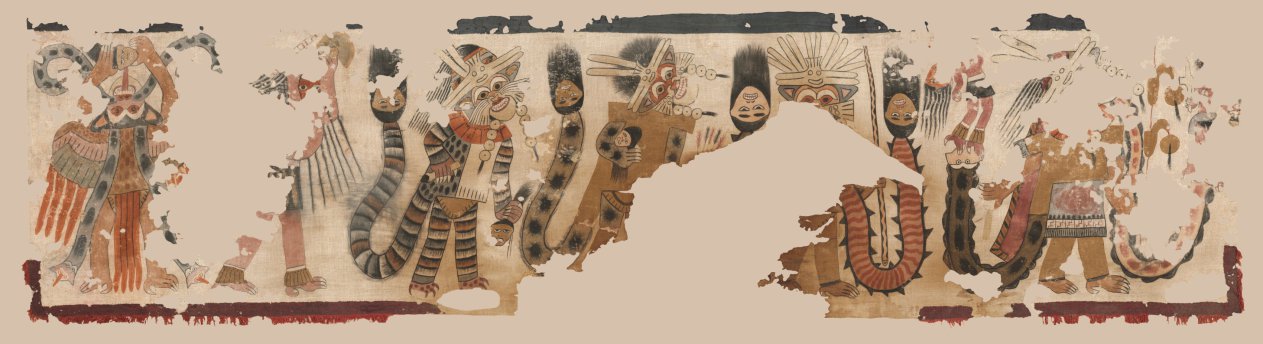
Cloth with Procession of Figures
-170–70
- Medium
- cotton and pigment (field); camelid fiber (borders and fringe)
- Dimensions
- Overall: 69.8 x 280.7 cm (27 1/2 x 110 1/2 in.); Mounted: 78.7 x 290.2 cm (31 x 114 1/4 in.)
- Genre
- Textiles
- Museum
- Cleveland Museum of Art
Styles
About
Experts agree that this cloth is one of the greatest paintings to survive from Andean antiquity due to the realism, complexity, large size, and refined execution of its figures. All but one of the figures wear the whiskered mouth mask of Nasca supernatural beings and several carry or wear severed human heads, which the Nasca linked to nature’s fruitfulness. Thus, the figures seem to represent supernatural forces or humans personifying such forces during a ritual devoted to agricultural fertility. Originally, the panel was attached along its upper edge to a dark blue cloth of equal size. The complete textile may have served as a mantle (a shawl-like garment), a hanging, or a funerary offering.