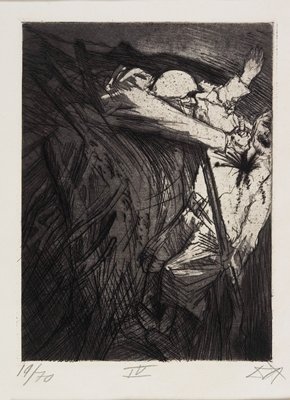
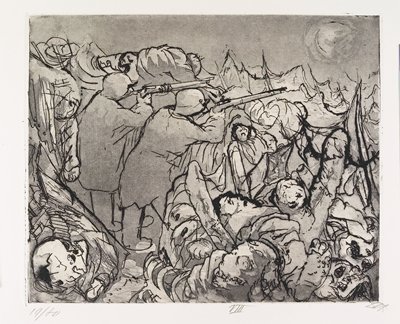
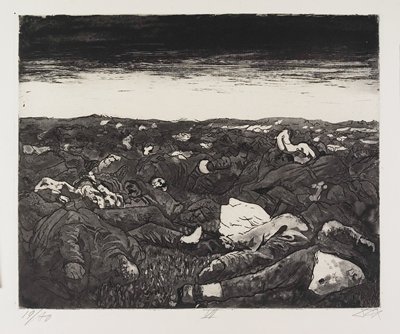
Dead Horse, from War
Otto Dix
1924
- Medium
- Etching on cream laid paper
- Dimensions
- Plate: 14.2 × 19.6 cm (5 5/8 × 7 3/4 in.); Sheet: 47.5 × 35.3 cm (18 3/4 × 13 15/16 in.)
- Genre
- Etching
- Museum
- Art Institute of Chicago
Tags
warprintprints and drawingetchingpaper (fiber product)
About
Otto Dix’s variable aesthetic choices emphasized his interest in previous Germanic artists. For example, in this highly worked print, the tuft of weeds silhouetted at the top of the image could easily reflect his study of premodern works by Albrecht Dürer, Matthias Grünewald, and other artists he admired. These devices distract viewers from the reality of death and destruction before their eyes, contributing to Dix’s overall point that the unthinking attitude toward the war was an unresolved problem in Weimar Germany.

![Fliehender Verwundeter (Sommeschlacht 1916) (Wounded Man Fleeing [Battle of the Somme 1916]), plate 10 from Der Krieg (The War)](https://1.api.artsmia.org/96543.jpg)




![Verschüttete (Januar 1916, Champagne) (Buried Alive [January 1916, Champagne]), plate 2 from Der Krieg (The War)](https://1.api.artsmia.org/96523.jpg)