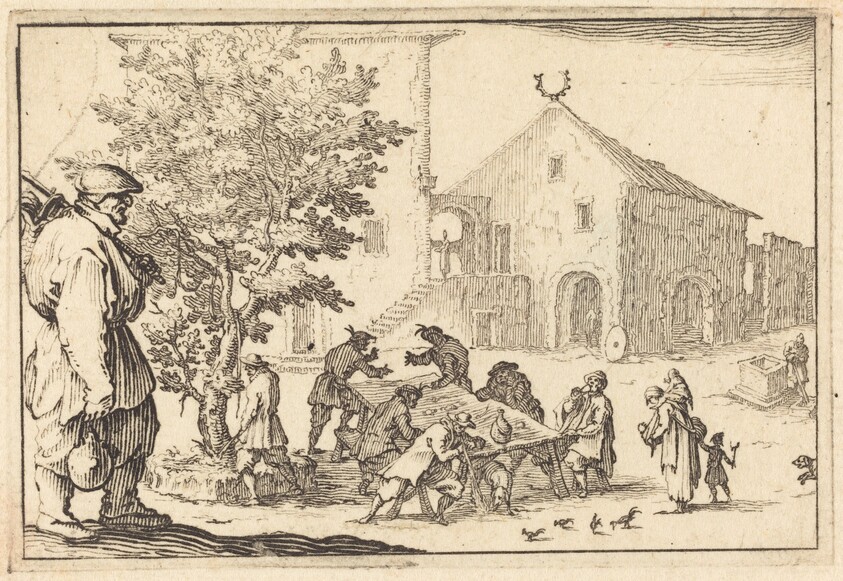
The Two Pantaloons Turning their Back, from The Caprices
Jacques Callot
1617–1627
- Medium
- Etching in black on ivory laid paper
- Dimensions
- Image/plate: 5.5 × 8 cm (2 3/16 × 3 3/16 in.); Sheet: 8 × 11.1 cm (3 3/16 × 4 3/8 in.)
- Genre
- Etching
- Museum
- Art Institute of Chicago
Tags
printprints and drawingetchingpaper (fiber product)
About
In the 17th century, the word capriccio generally indicated a musical composition that thwarted listeners’ expectations with sudden changes in tempo, rhythm, or structure that appeared to be made according to the performer’s whim, or caprice. Jacques Callot borrowed the term to describe a series of etchings with a wide variety of diverting subjects including peasants, architectural sites, military maneuvers, and musicians. Among other motifs, he depicted two pairs of dancers frolicking and playing musical instruments and a shepherd playing a flute.