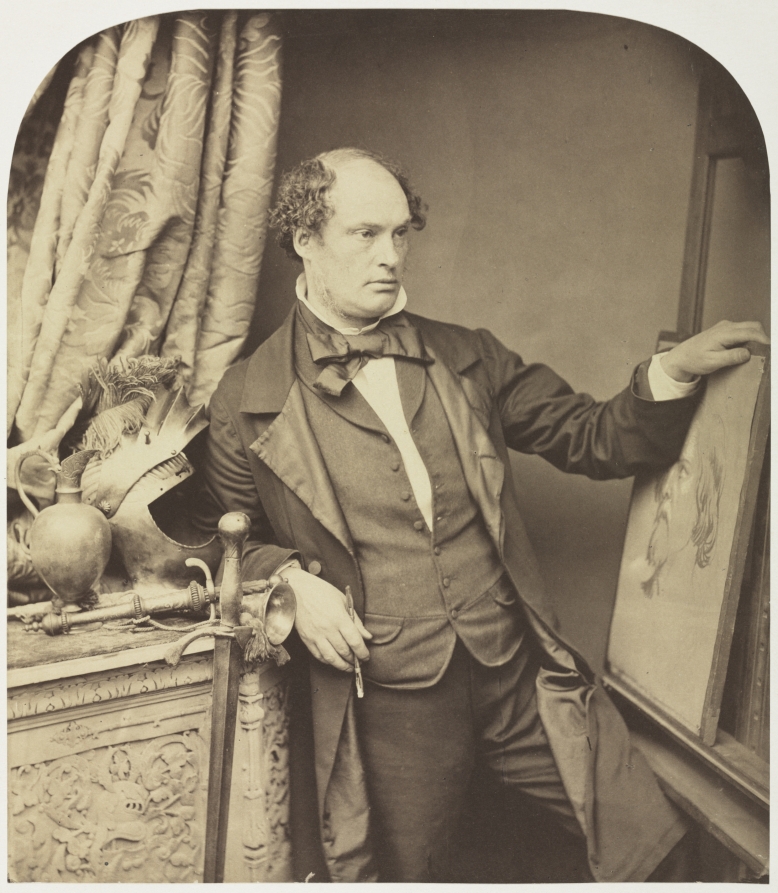
William Lake Price (British, 1810–1896)
b. 1810 — d. 1896
William Lake Price British, 1810-1896 William Lake Price was trained as an architectural and topographical artist in the studio of Augustus Charles Pugin. Price's work, exhibited at the Royal Academy between 1828-32 and at the Old Watercolour Society between 1828-52, consisted primarily of antiquarian, portrait, and topographical views, including the stately interiors, historical subjects, and genre scenes typical of the era. Turning to photography in the mid-1850s, Price espoused the same sensibility that had served him in painting. He joined the Photographic Society in London and submitted as his first entry in the annual Photographic Album for the Year 1855 the sort of genre scene that would ensure his popularity for some time. In 1858 he published a collection of portraits entitled Portraits of Eminent British Artists. Price, like Oscar G. Rejlander and Henry Peach Robinson, advocated an approach to photography associated with the fine arts. All used methods of composite or combination printing, in which scenes were composed in studies and sketches, and then assembled by combining a variety of individual prints. The resulting composition was rephotographed as the final work. Price wrote extensively on this process and other technical subjects in photography, publishing A Manual of Photographic Manipulation: Treating of the Practice of the Art and Its Various Applications to Nature (1858). His photograph Don Quixote and a series on Robinson Crusoe reveal the sentimental nature of his most popular works. T.W.F.