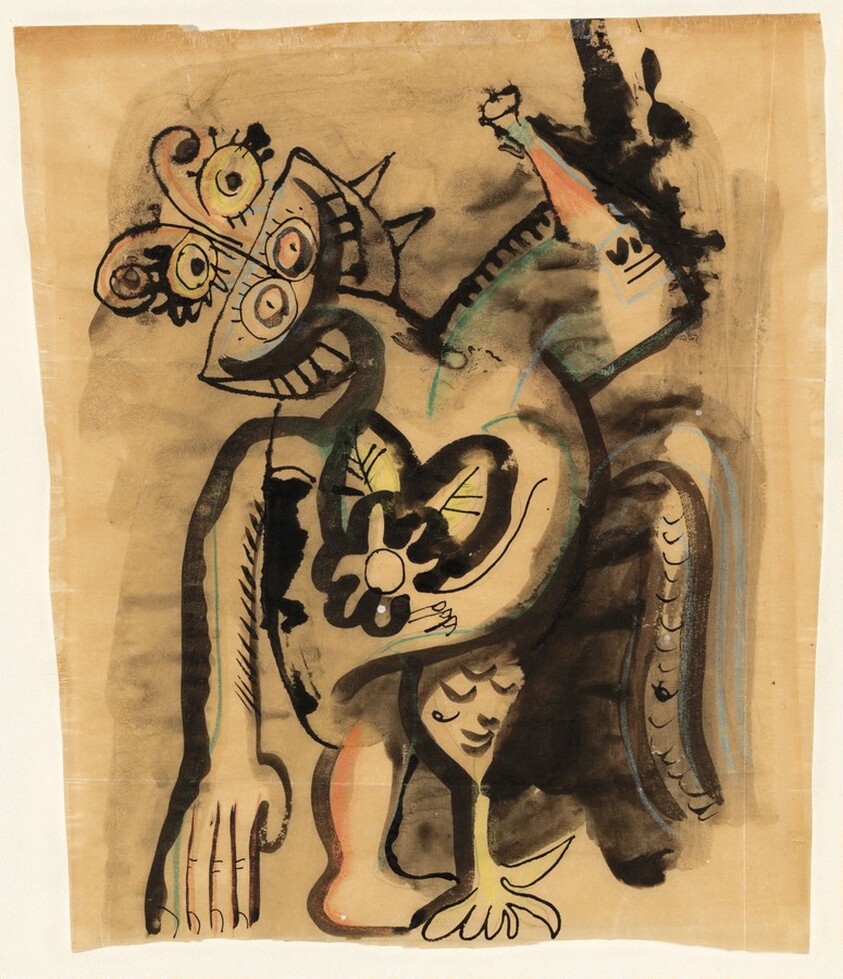
Wifredo Lam
Sagua la Grande, Cuba · b. 1902 — d. 1982
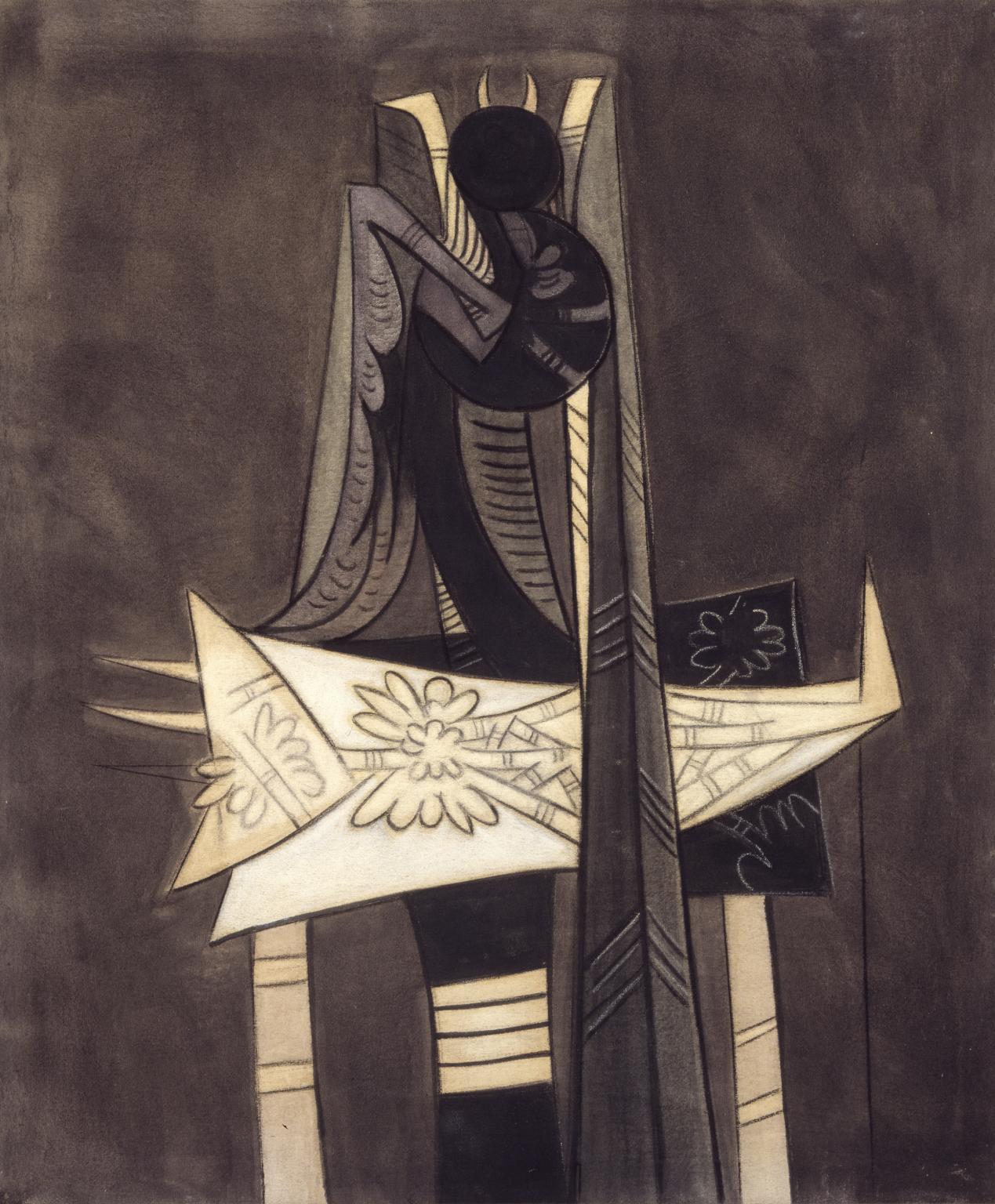
Wifredo Lam merged Cubist and Surrealist ideas with spiritual imagery from his native Cuba, creating a body of paintings with a transcultural visual vocabulary. Lam was born on the northern coast of Cuba and began his academic training as a painter in Havana as a teenager. He continued his studies in Spain, where he lived for almost 15 years, before departing for Paris in 1938, in the midst of the Spanish Civil War. Upon arriving in Paris, Lam sought out Pablo Picasso [https://www.artic.edu/artists/36198/pablo-picasso], and the two of them began to meet almost daily. Through Picasso’s friendship, he developed relationships with Fernand Léger [https://www.artic.edu/artists/35363/fernand-leger] and Georges Braque [https://www.artic.edu/artists/33739/georges-braque], as well as members of the Surrealist group, such as Joan Miró [https://www.artic.edu/artists/32048/joan-miro] and André Masson [https://www.artic.edu/artists/35656/andre-masson]. Throughout 1940–41, Lam took a slow and arduous journey back to Havana, spending interludes in both Marseille and Martinique alongside fellow Surrealists Max Ernst [https://www.artic.edu/artists/34418/max-ernst] and André Breton [https://www.artic.edu/artists/3226/andre-breton]. Once in Havana, his previous exploration of Cubist forms and Surrealist ideas began to fuse with his long-standing interest in the symbolism of Cuban Santería—a religion that combines elements of Catholicism and West African Yoruba. These ideas coalesced into verdant and vigorous jungle landscapes, such as Study for “The Jungle” [https://www.artic.edu/artworks/118704/study-for-the-jungle] (1942), in his first years back in Havana. Over the course of the 1940s and 50s, and as he began to spend more time in Paris again, Lam’s engagement with Santería became more rigorous and complex, evolving into images densely layered with religious meaning and populated with potent, razor-sharp forms, such as in Caos-caos [https://www.artic.edu/artworks/236501/caos-caos] (about 1950).
Timeline
Born 1902 — Died 1982

1930s
1940s


1960s
![[no title]](https://media.tate.org.uk/art/images/work/P/P03/P03248_10.jpg)