Tom Thomson
b. 1877 — d. 1917
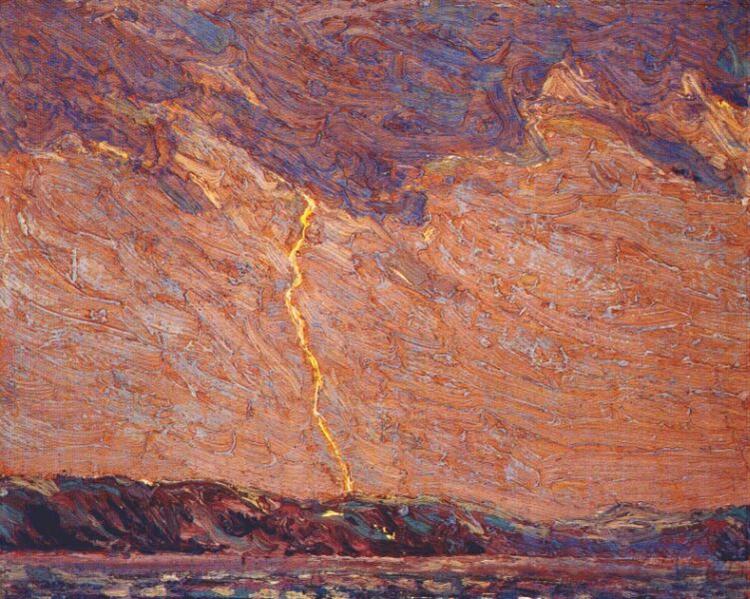
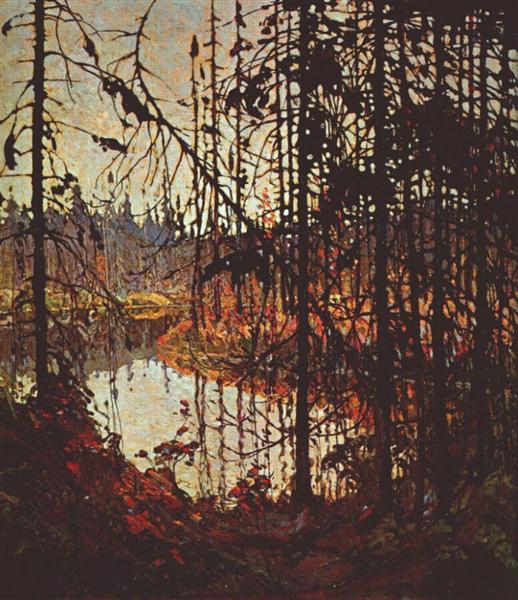
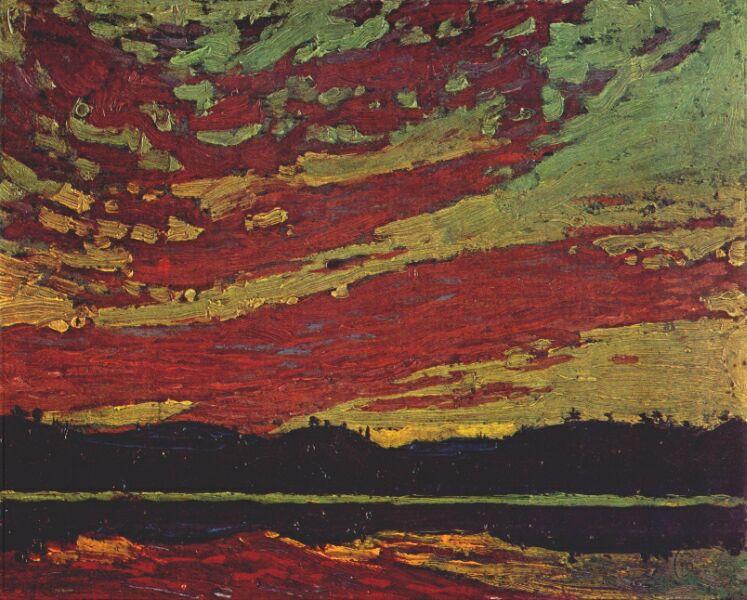
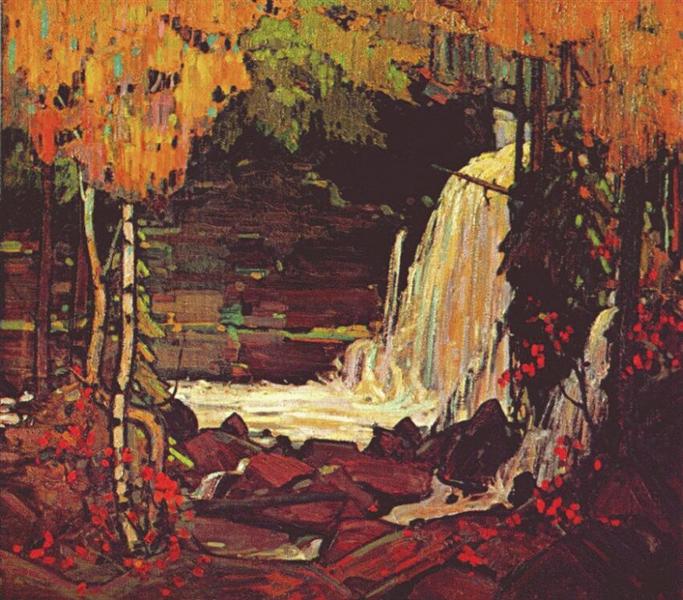
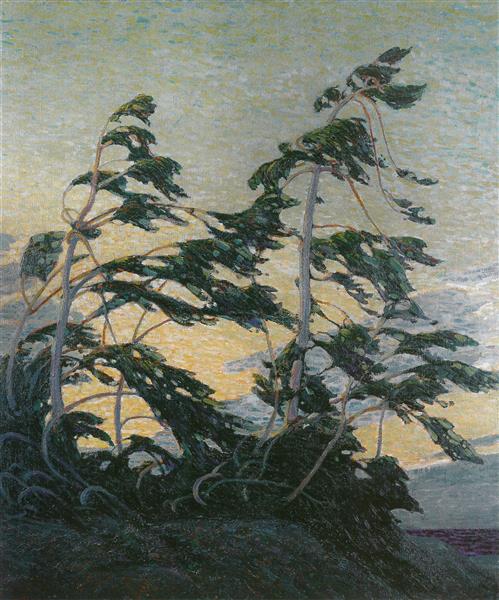
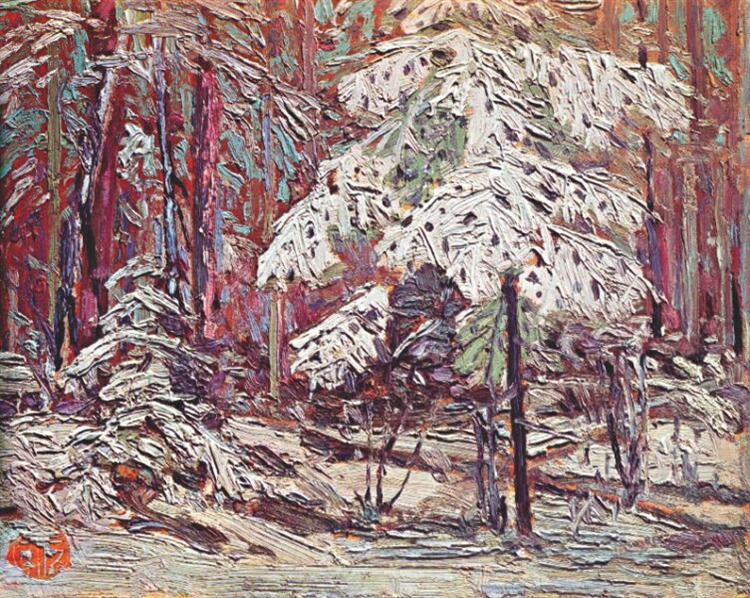
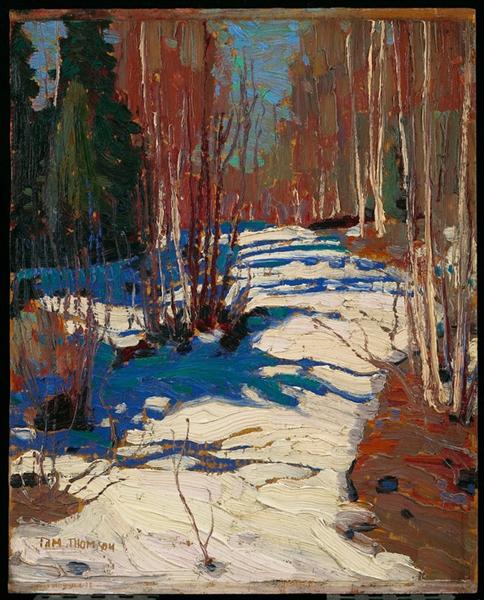
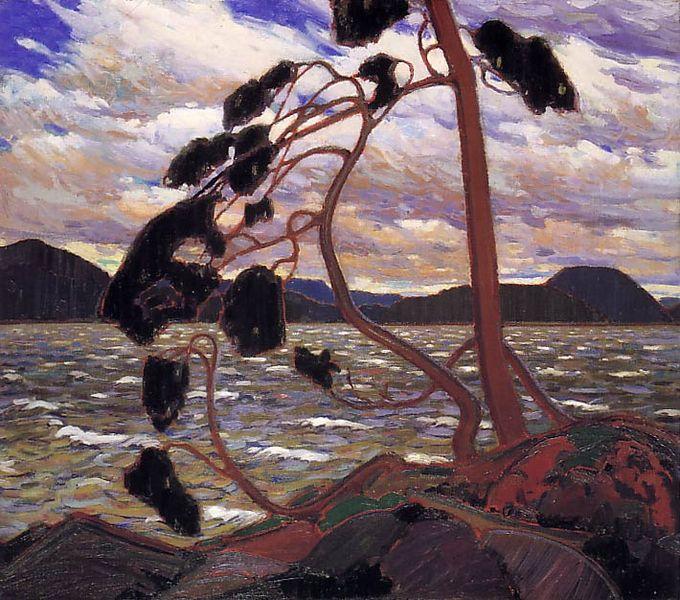
Tom Thomson was the most influential and enduringly popular Canadian artist of the early 20th century. An intense, wry, and gentle artist with a canny sensibility, he was an initial inspiration for what became the [url href=https://www.wikiart.org/en/artists-by-painting-school/group-of-seven]Group of Seven[/url]. He was one of the first painters to give acute visual form to the Canadian landscape. His works portray the natural world in a way that is poetic but still informed by direct experience. He produced about 50 canvases and more than 400 sketches in his short professional career. Many of his paintings, such as [url href=https://www.wikiart.org/en/tom-thomson/the-west-wind-1917][i]The West Wind[/i][/url] (1916–17) and [url href=https://www.wikiart.org/en/tom-thomson/the-jack-pine-1917][i]The Jack Pine[/i][/url] (1916–17), have become icons of Canadian culture. His legend only grew after his mysterious untimely death at the age of 39. The sixth of ten children, Thomson grew up on a farm in Southwestern Ontario. One of his older relatives, Dr. William Brodie, was a director of the Biological Department of what is now the Royal Ontario Museum; he trained young Thomson as a naturalist. From Brodie, Thomson learned how to combine keen observation of nature with a sense of reverence for its mystery. Later, he enrolled in the Canada Business College in Chatham; he attended the Acme Business College in Seattle, a school run by his eldest brother and a cousin. In terms of his development as a painter, Thomson’s experience up to this point was primarily that of an amateur. In order to become a professional artist, he had to overcome numerous obstacles, such as his lack of knowledge of the technical side of painting. In 1906, he enrolled in night school at the Central Ontario School of Art and Industrial Design — the precursor to today’s Ontario College of Art and Design University. In 1912, Thomson embarked on a fishing trip to Algonquin Park, the first provincial park in Canada. His sketches from this trip showed a tremendous advance and marked his real start as an artist. They depict the wilderness as a vast world that seems unsullied by human civilization. They portray the natural world in a way that is poetic but still informed by direct experience. To develop his first major painting, [url href=https://www.wikiart.org/en/tom-thomson/northern-lake-1913][i]Northern Lake[/i][/url] (1913), Thomson selected one of those sketches and transformed it into a picture with greater depth in the foreground. This method of working from an on-the-spot sketch to a finished studio painting became his common practice. These two ways of working reveal contrasting sides of Thomson’s artistic personality. The sketch, with its vivacity and on-the-spot reportage, recalls the spontaneity of a lyric poem. The canvas created in the studio, with effects adapted from such styles as [url href=https://www.wikiart.org/en/paintings-by-style/art-nouveau-modern]Art Nouveau[/url] and [url href=https://www.wikiart.org/en/paintings-by-style/post-impressionism]Post-Impressionism[/url], is akin to an epic poem. By 1914, Thomson was transposing, eliminating, and applying various types of design to his work to evolve his conception of landscape painting. This would eventually become the basis for a style that would bring national prominence to the Group of Seven, a movement that infused a growing Canadian consciousness into the practice of landscape painting. Thomson had informally discussed his ideas about this new approach with founding members of this group, [url href=https://www.wikiart.org/en/j-e-h-macdonald]J.E.H. MacDonald[/url] and [url href=https://www.wikiart.org/en/lawren-harris]Lawren Harris[/url]. By 1915, Thomson was creating the oil paint sketches and canvases that have come to represent Canada as it is imagined by most Canadians. At 37 years of age, he was living in Algonquin Park from spring to autumn (at times serving as a fishing guide and a fire ranger), and in Toronto during the winter. He shared Studio One of the Studio Building in Toronto with [url href=https://www.wikiart.org/en/a-y-jackson]A.Y. Jackson[/url], and then, when Jackson left, with [url href=https://www.wikiart.org/en/franklin-carmichael]Franklin Carmichael[/url]. Thomson eventually moved to a shack attached to the building. Here he painted his large canvases and entertained friends. On 8 July 1917, Thomson embarked from Canoe Lake in Algonquin Park in a canoe loaded with equipment and supplies. His upturned canoe was found later that day and his body was found in the lake eight days later. The cause of his death was ruled as “accidental drowning,” though the inquest that reached that conclusion was criticized as being rushed. A police investigation was never conducted. The circumstances surrounding Thomson’s death have taken on a mythological life of their own. Writers, amateur sleuths, and serious scholars have proposed various theories over the years. An examination of Thomson’s works reveals how quickly he came into his own. An amateur artist, he found his very distinctive path by 1914. Nature was clearly his touchstone, and throughout his career, he turned to it as his muse. His method was to capture transient moments of light and atmosphere by sketching quickly in oil from nature, sometimes developing these sketches into full-blown celebrations of the land. His evolution was toward relaxed, brilliant handling of paint. At his best, Thomson disposed trees and bushes in his paintings like notes in a finely phrased tune, creating patterns that interlocked in intricate counterpoint. Thomson’s pictures, with their vibrant colors, often have a sense of movement, dynamism, and drive. His best-looking paintings to contemporary viewers are his lively sketches with their strong forms. Executed in a palette of red, pink, brown, light and dark blue, with a finesse suited to a naturalist, Thomson’s paintings embody a genuinely national vision.
Timeline
Born 1877 — Died 1917