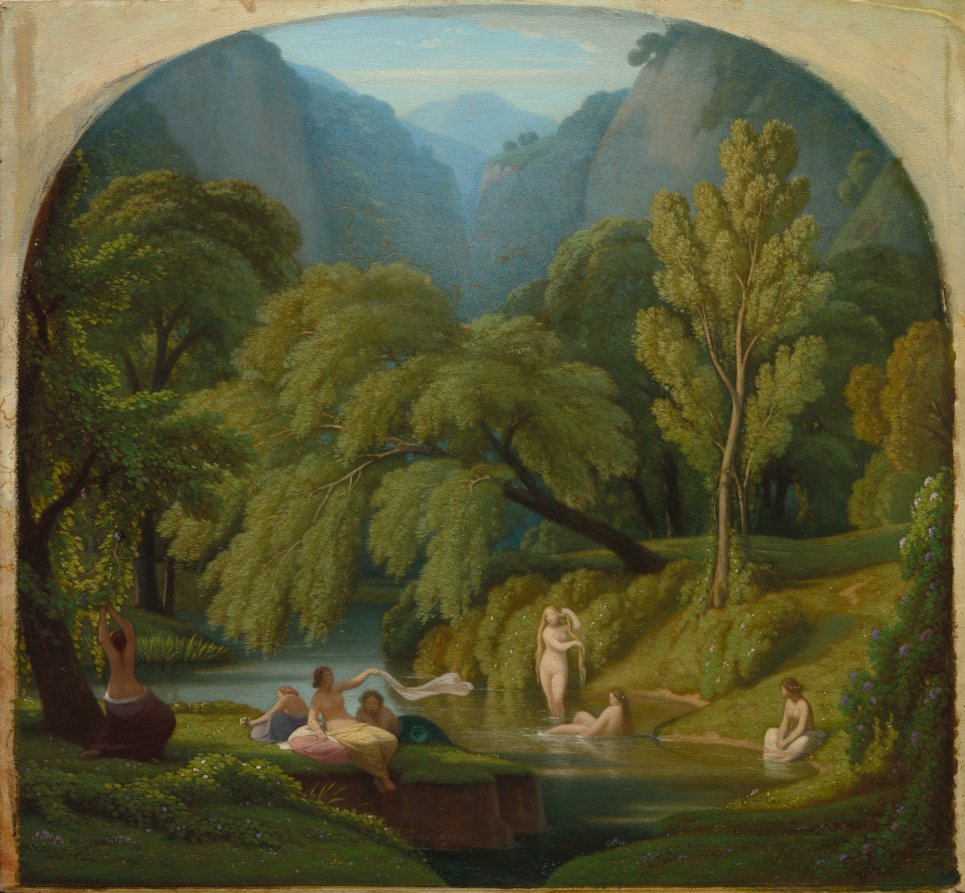
Théodore Caruelle d' Aligny
b. 1798 — d. 1871
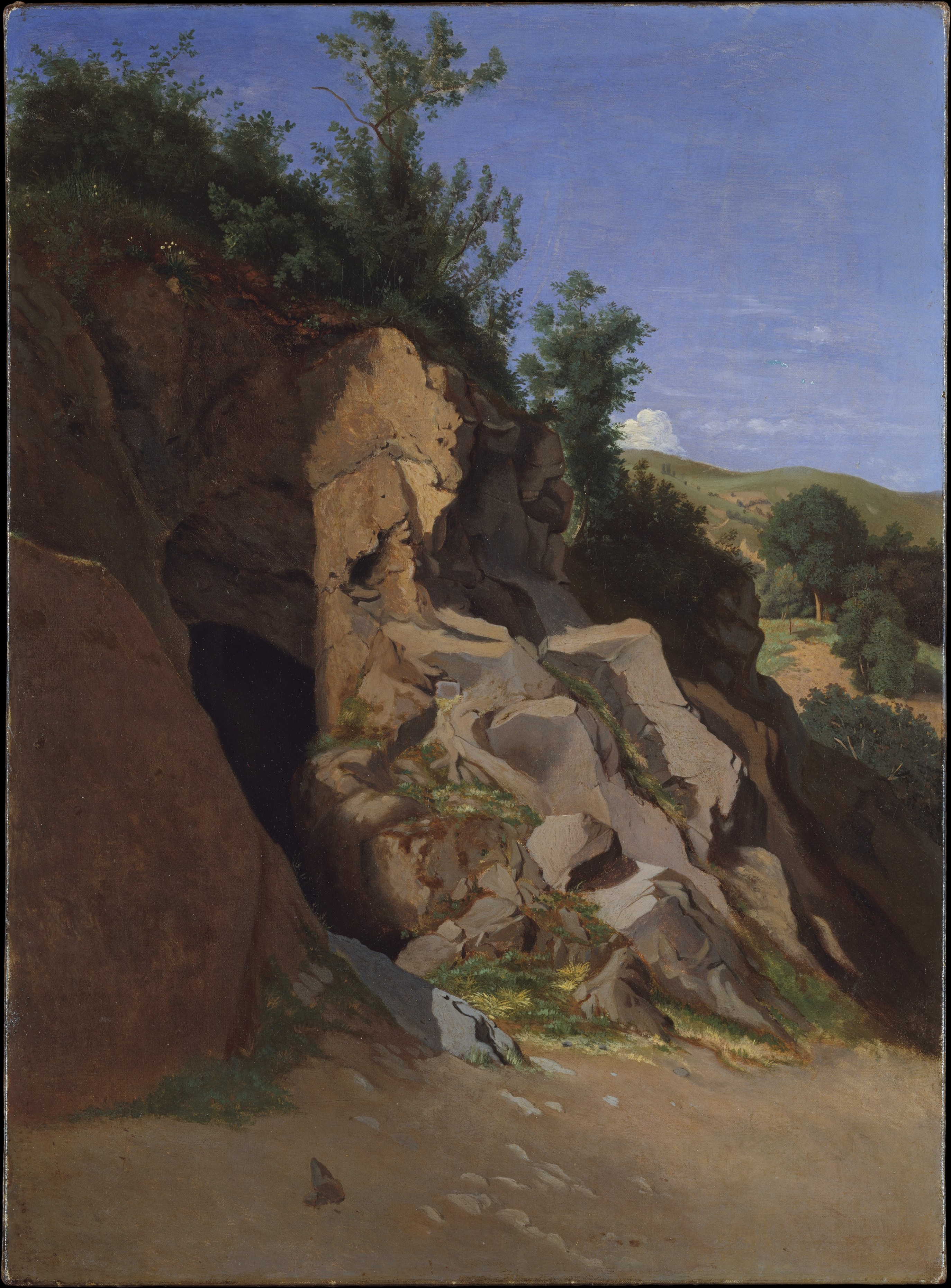
Théodore Caruelle d'Aligny's early artistic practice was spent in the ateliers of mythological genre painter Jean-Baptiste Regnault (1754-1829) and landscape artist Louis-Étienne Watelet (1780-1866). Aligny first exhibited at the Salon of 1822 with Daphnis and Chloé (location unknown), which received little notice. As was the custom for artists in the nineteenth century, Aligny made a pilgrimage to Italy, where he remained until 1827. While in Rome, he met Corot (q.v.), whom Aligny acknowledged as his master, although Corot was only two years older. Aligny traveled and sketched in the Roman countryside with Corot, Édouard Bertin (1797-1871), Prosper Barbot (1798-1878), and Léon Fleury (1804-1858). Characteristic of Aligny's landscapes is a detailed study of nature based on careful observation and medi-tation. He made numerous drawings and oil sketches directly from nature for his own study and for finished paintings, which would be completed in his studio. Upon his return to Paris in 1827, he exhibited in the Salon of that year, where he again attracted little attention. The following year marked the beginning of frequent retreats to the forest of Fontainebleau near Paris, where he often sketched en plein air alongside Corot, Diaz de la Peña (q.v.), and Rousseau (q.v.). Aligny began exhibiting regularly at the Salon after 1831, when one of the six landscape paintings he entered won him a second-class medal. In 1837 he received a first-class medal for Prometheus on the Caucasus (Musée du Louvre, Paris), a work that was bought by the state. As a result, landscape painters seeking apprenticeship flocked to his studio the following years, and he received numerous state commissions. In 1861 Aligny accepted the position of director of the École des Beaux-Arts in Lyons, where he resided, worked, and continued to sketch after nature until his death in 1871.
Timeline
Born 1798 — Died 1871

1840s