Alexander Bazhbeuk-Melikyan
b. 1891 — d. 1966
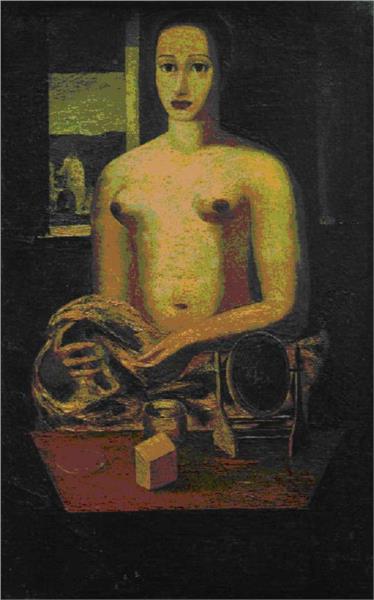
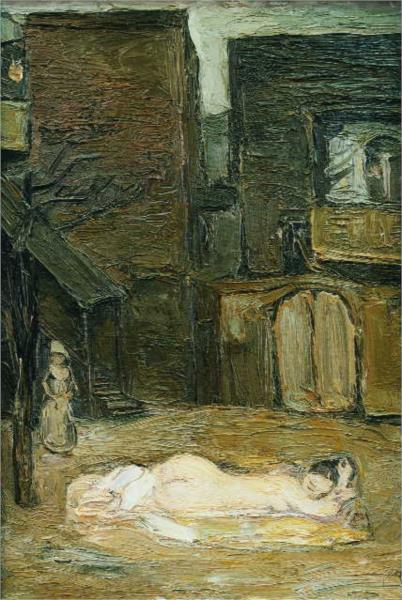
Alexander Alexandrovich Bazhbeuk-Melikyan was born in Tbilisi, Georgia. In 1903, he began his studies at the School of Art and Sculpture of the Caucasus Society for the Encouragement for the Fine Arts. Here he made the acquaintance of a fellow student, Lado Gudiashvili. In 1910, he travelled to Moscow to begin training in the studio of the artist V. N. Meshkov. The following year, he joined the St. Petersburg Academy of Arts. In 1913, Bazhbeuk-Melikyan was drafted into the Imperial Russian Army, and spent the World War I years on the Odessa front. In 1917, he returned to Tbilisi and began his own independent artistic career. In 1919, he met his first wife, Nektar, with whom he had one daughter, Lavinia (born in 1922). From a later marriage to Lydia Meshkorudnikova, he had two more children: a son, Vazgen, and a daughter, Zuleika. Both daughters were to become artists in their own right. Between the years 1922 - 1929, Bazhbeuk-Melikyan taught at the studio of Mose Toidze, following which he taught at the Georgian Academy of Arts till 1938. In the 1920s, Bazhbeuk-Melikyan was an active participant in the Tbilisi avant-garde, collaborating with Futurists such as the poet Kara-Darvish, and Georgian painters such as David Kakabadze. In 1935, Bazhbeuk-Melikyan became friends with the nationalist poets Yegishe Charents and Titian Tabidze, which led to the attention of the NKVD. When, in 1937, the newspaper Dawn of the East published an article naming him an enemy of the people, he was expelled from the Union of Artists of Georgia. Charents and Tabidze were both executed that same year, and Bazhbeuk-Melikyan lived in fear of arrest. That did not come to pass, and when he painted his Spanish guerrillas in support of the Republicans in the Spanish Civil War, he was rehabilitated.[2] In 1961, he was awarded the title of Honored Artist of the Georgian Soviet Socialist Republic. His family estimates that Bazhbeuk-Melikyan painted over two thousand canvases, but ruthlessly pruned them down to about a hundred. Given his perfectionism, every time he created a new work, he would go over his old paintings and destroy any that did not meet his uncompromising standard. When his daughter Lavinia created a catalogue of his paintings in 1936, there were 110 pieces. In 1966, after his death, there still were only 110 works remaining.
Timeline
Born 1891 — Died 1966
.jpg!Large.jpg)